
In my more than three decades in metal finishing, one lesson has stayed with me: a component is not ready simply because the cutting operation is complete. Its edges and surfaces must also meet the requirements of the next process.
A manufacturer may invest in a faster laser or plasma cutting machine, yet the parts still move to a manual grinding station. If finishing cannot keep pace, production waits. The benefit of faster cutting is then partly lost in additional handling, grinding and inspection.
For automotive suppliers, earthmoving equipment manufacturers and makers of road and building construction equipment, this deserves attention. Whether you are a Tier 1, Tier 2 or Tier 3 supplier, the customer judges the finished component—its quality, consistency and timely delivery.
Before investing in more cutting capacity, I encourage manufacturers to ask one practical question:
“Our cutting machine is fast. Is our finishing process keeping up?”
That question is the starting point for understanding the hidden cost after cutting.
Where the hidden cost begins
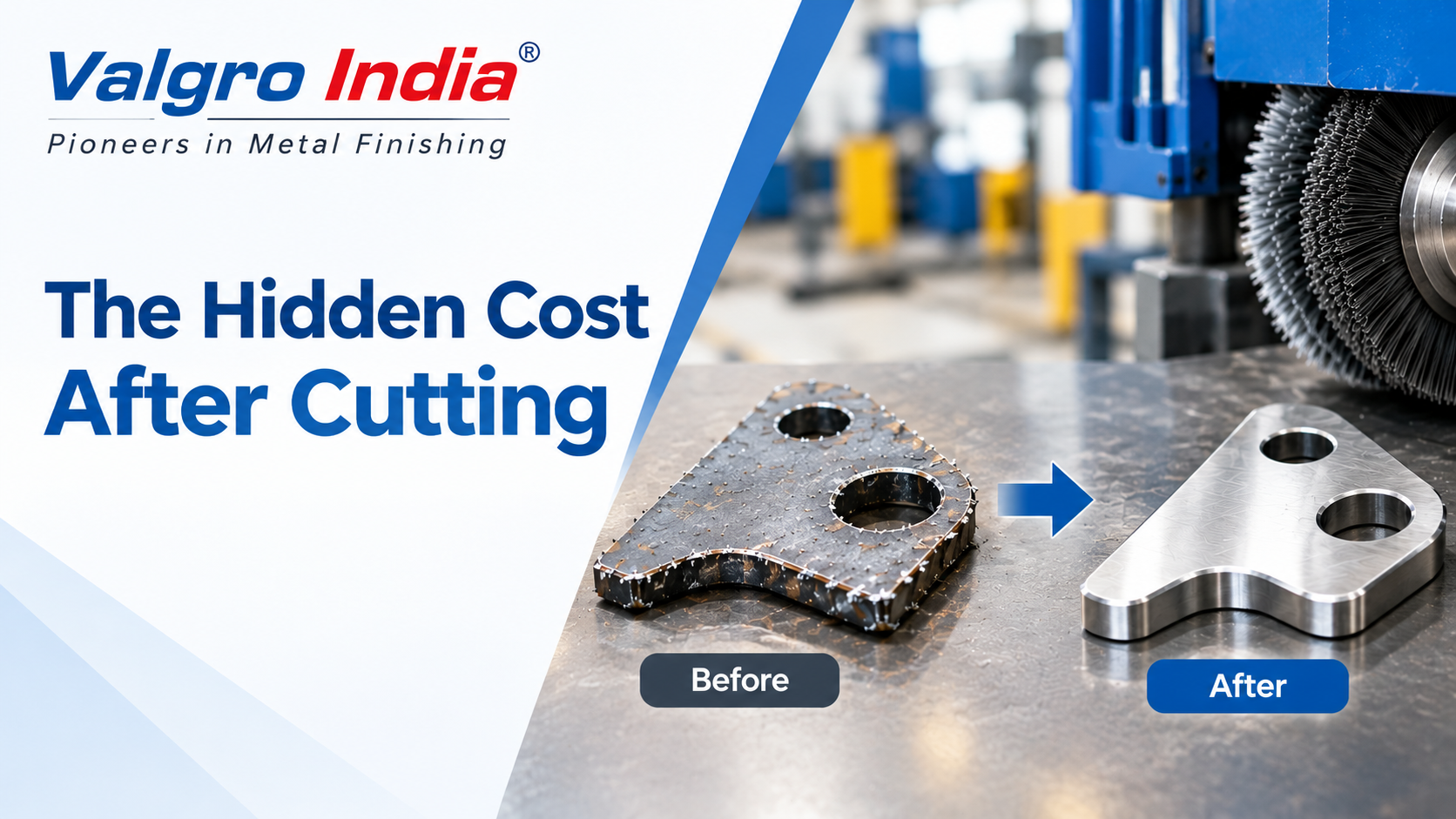
Laser cutting, plasma cutting, punching and shearing produce different edge conditions depending on the material, thickness, tooling and process settings. Some components leave the machine with acceptable edges. Others need further treatment to meet the drawing or the requirements of the next operation.
When this work depends on repeated manual grinding, the cost extends beyond the operator’s time. Components must be moved, handled, inspected and sometimes processed again. Consumables are used. Parts may wait for an experienced operator. Excessive grinding can affect dimensions, appearance or functional surfaces.
These costs are easily overlooked when manufacturers measure only cutting speed or machine utilisation. A more useful measure is the total cost and time required to produce an accepted component.
A common challenge across supplier tiers
Tier 1, Tier 2 and Tier 3 manufacturers operate at different scales, but each must deliver parts that meet customer requirements consistently.
For Tier 1 suppliers, repeatable edge quality supports dependable production flow and customer acceptance. Tier 2 manufacturers need processes that remain consistent across changing batches and component designs. Tier 3 manufacturers need practical, affordable improvements that simplify work and control cost per accepted part.
The same principle applies to heavier fabrication. Components for excavators, loaders, road machinery and construction equipment may require treatment of substantial cutting burrs or slag, together with specified edge preparation. Their size, weight and geometry influence how the process should be designed.
Across these applications, the goal is clear: define the required condition and produce it reliably.
“Remove the burr” is only the beginning
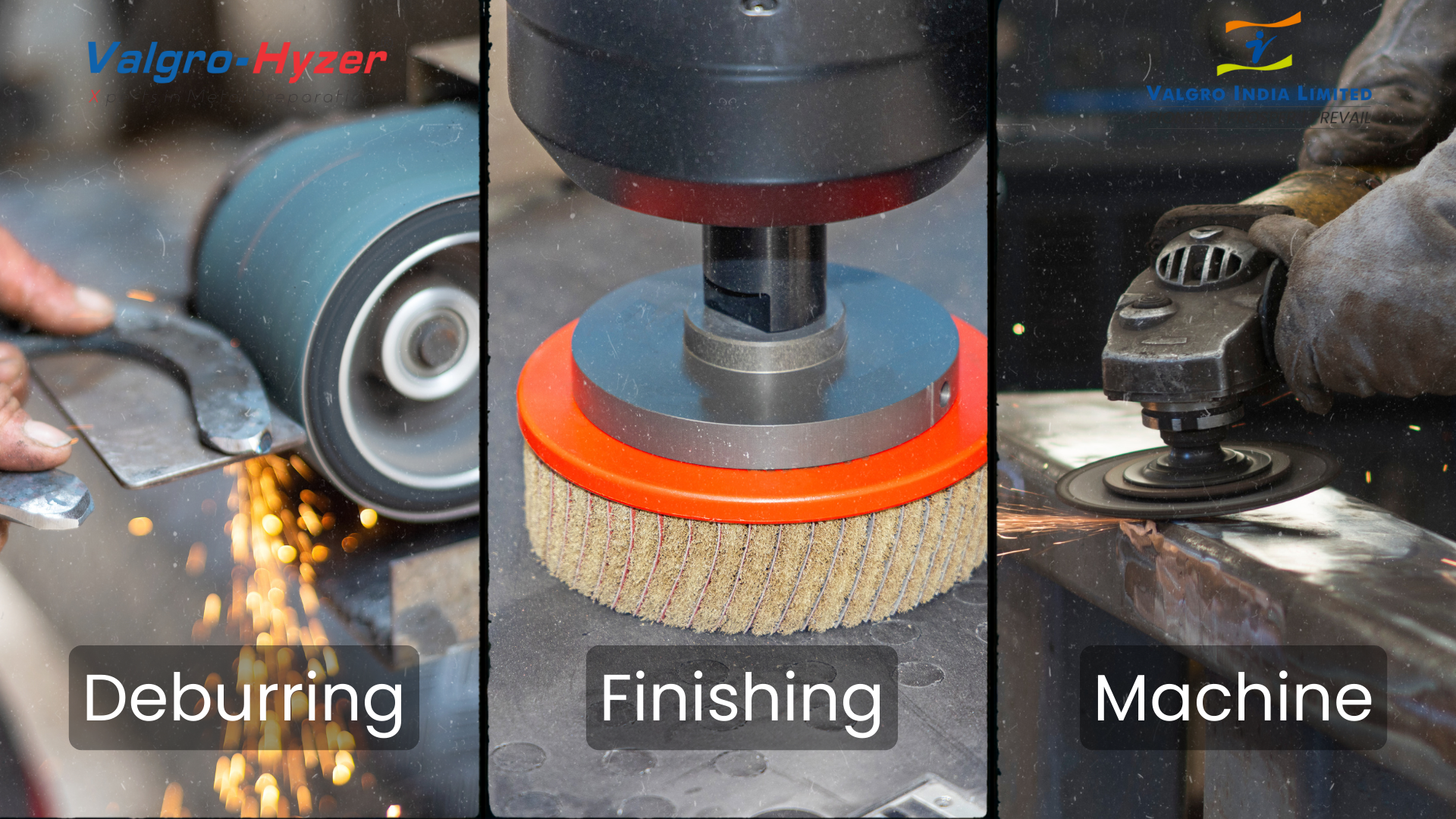
Deburring, edge rounding, slag removal and surface finishing are related operations, but they serve different purposes.
Deburring removes unwanted material left by manufacturing. Edge rounding creates a specified edge profile. Slag removal addresses attached material from thermal cutting. Surface preparation conditions the surface for a subsequent operation or required finish.
A component that feels smooth to the hand may still fail a specified edge requirement. Likewise, an attractive surface does not confirm that every hole, slot or internal contour has been adequately processed.
The requirement must therefore be measurable: permitted burr condition, required edge break or radius, dimensional limits and relevant surface criteria. Where coating follows, preparation must also match the coating system and its specified pretreatment. Where welding requires a defined bevel, that requirement must be addressed separately.
From individual skill to a controlled process
Experienced operators remain valuable. A controlled finishing process gives them clear settings, suitable tools and defined acceptance criteria.
Depending on the application, mechanised or automated finishing can help reduce variation and repeated handling. The appropriate solution must account for material, part dimensions, thickness, weight, cut quality, production volume and the next manufacturing operation.
Automation should follow a clear understanding of the work. A machine that suits thin automotive brackets may not suit heavy plasma-cut plates. Small parts, delicate surfaces and internal features also require careful evaluation.
The Valgro approach: start with the application
Valgro India Limited’s approach to metal surface preparation begins with the customer’s component and production challenge.
The starting questions are practical: What material is being processed? How was it cut? What burr or surface condition is present? What does the customer drawing require? How many accepted parts are needed per shift? Where does the current process lose time?
Representative sample trials provide a sound basis for evaluating the solution. Results should be assessed against agreed criteria, including cycle time, edge condition, dimensional preservation, surface quality, labour involvement and consumable use.
This approach supports informed selection of deburring, brushing, edge rounding and finishing processes. The objective is an improvement that works with the customer’s actual part mix and production needs.
Make finishing part of the productivity conversation
Improving cutting capacity is valuable. Matching it with suitable finishing capacity helps that investment contribute to completed production.
For manufacturers across the supply chain, the opportunity is to treat edge quality as a planned manufacturing requirement—with defined inputs, controlled processing and verified results.
As the industry gathers for MOTOTECH Pune 2026, Valgro invites manufacturers to discuss the challenges between cutting and the next operation, and explore application-based solutions through component evaluation and trials.
BRING YOUR PART. DEFINE YOUR FINISH. DISCOVER YOUR VALGRO SOLUTION.
VALGRO INDIA LIMITED
Deburring. Edge Rounding. Surface Preparation.
Inspired by German Engineering. Innovated in India. Trusted Worldwide.
MOTOTECH Pune 2026 | 30–31 October 2026
Auto Cluster Exhibition Center, Pune
Website: www.valgroindia.com
Contact: +91 98250 28847