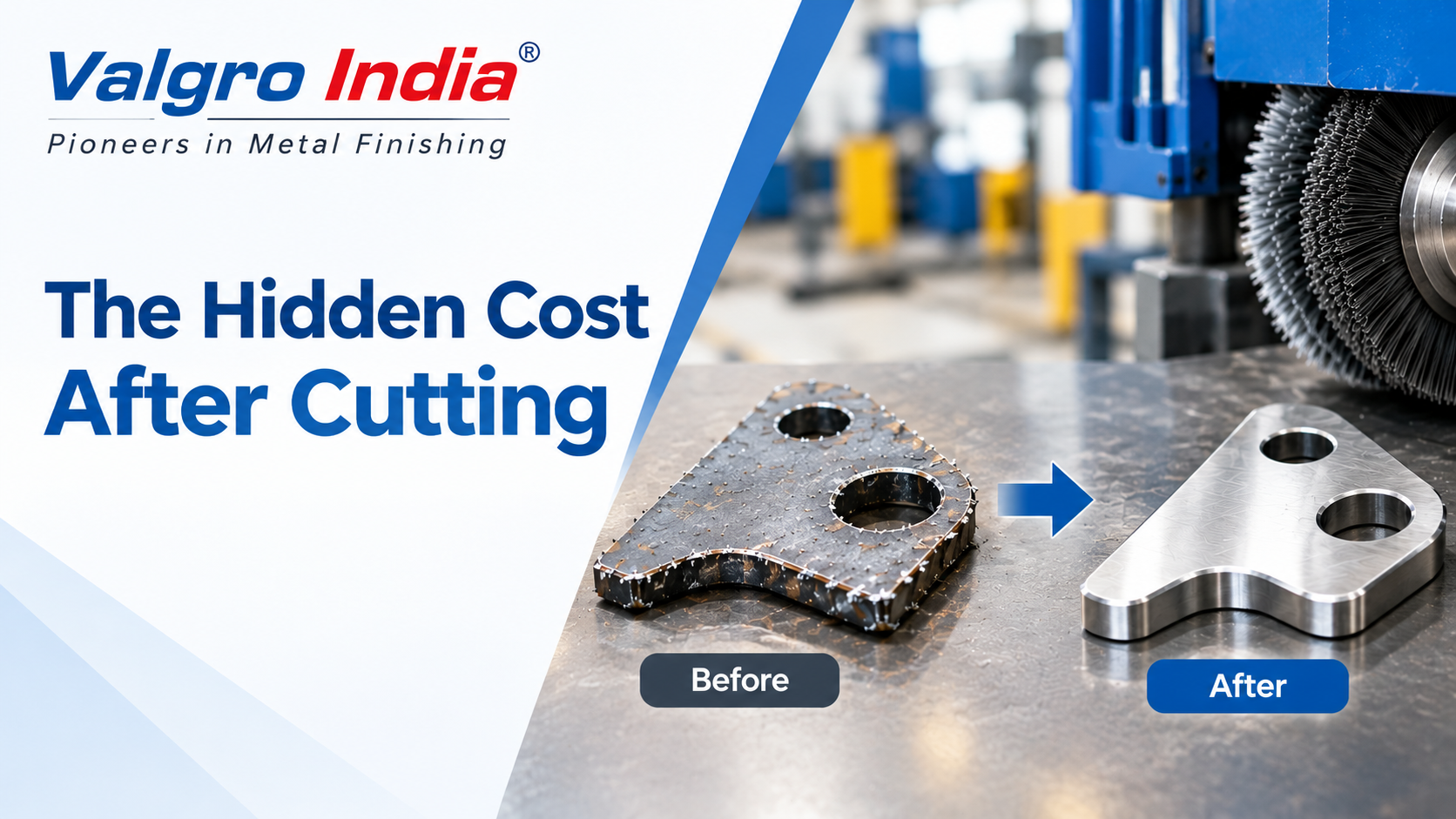

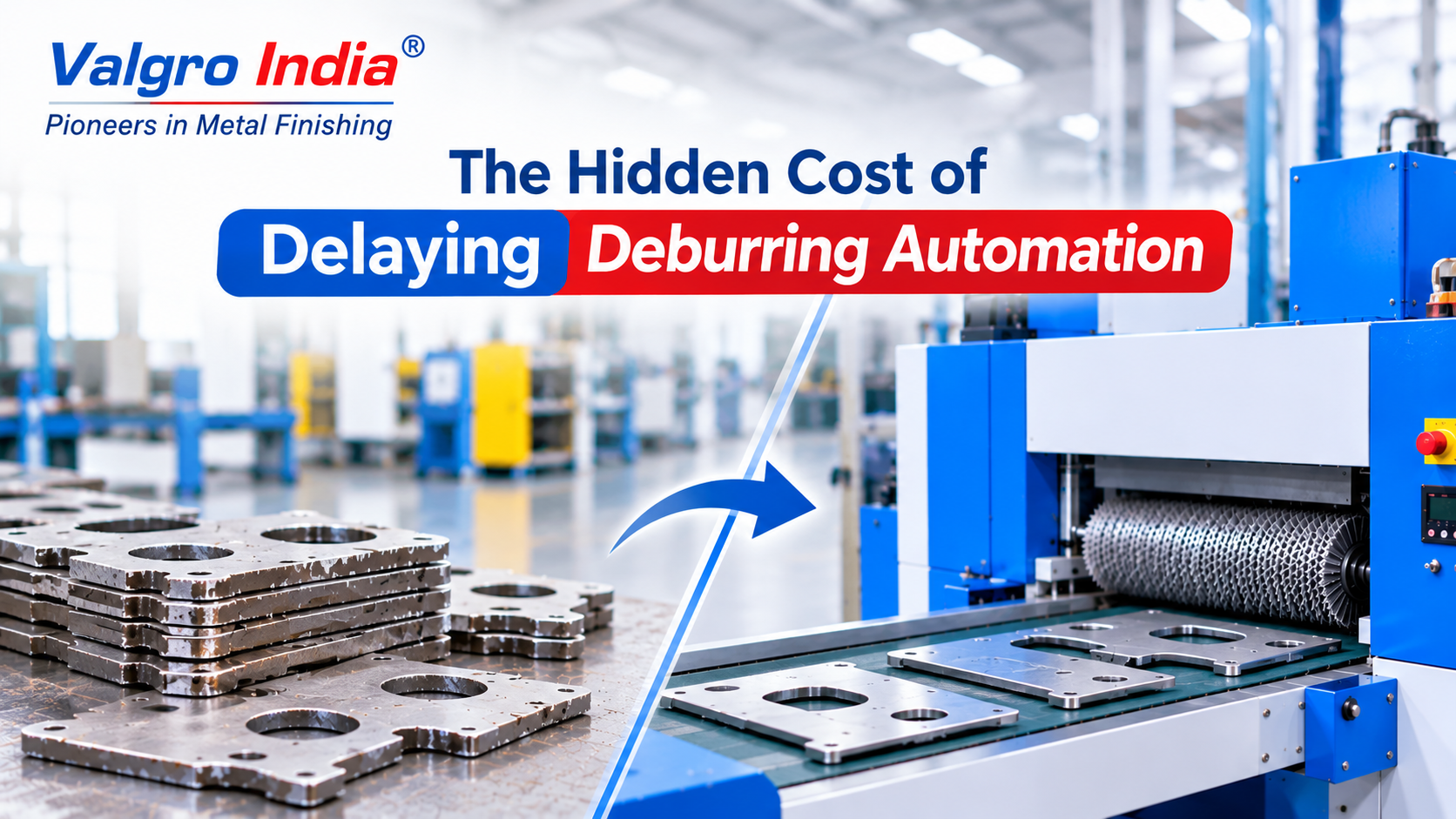
Manual Deburring May Look Cheaper, but Delaying Automation Makes It Far More Expensive.
By Dr. Arvind B. Patel
Founder, Valgro India Limited | Metal Finishing Expert | Manufacturing Innovation & Automation
In manufacturing, every rupee matters. Companies invest heavily in advanced laser cutting, punching, CNC machining, and fabrication technologies to improve productivity and precision.
But one critical process often remains neglected: Deburring and Edge Finishing.
Even after investing crores in modern manufacturing equipment, many factories still rely on manual grinding, deburring, and edge finishing.
The question is simple: Why invest in advanced cutting technology and still finish the same parts manually?
The answer is usually the same: “Manual deburring is cheaper.”
But is it really?
1. The Hidden Cost of Manual Deburring
Manual deburring may require less initial investment, but its actual cost extends far beyond operator wages.
Consider the hidden expenses:
- Labour dependency: Production depends on operator availability and skill.
- Inconsistent quality: Edge rounding and surface finish vary from operator to operator.
- Low productivity: Manual processes can create bottlenecks after high-speed cutting.
- Rework and rejection: Uneven finishing can increase quality-related costs.
- Operator safety: Repetitive grinding exposes workers to dust, noise, vibration, and injury risks.
- Limited scalability: Increasing production often means adding more operators.
These expenses accumulate silently, month after month.
2. The Biggest Loss Is Not Labour Cost. It Is Lost Productivity.
Imagine a factory equipped with advanced laser cutting machines producing hundreds or thousands of components daily.
Cutting is fast. Technology is modern. Production targets are ambitious.
But the finished parts are waiting for manual deburring.
What happens?
Work-in-progress increases. Delivery schedules become difficult. Quality becomes dependent on individuals, and production efficiency suffers.
Your modern cutting machine produces at industrial speed, but your finishing process may still operate at manual speed.
This mismatch can become a significant barrier to growth.
3. Automation Is About More Than Replacing Labour
The real objective of deburring automation is not simply reducing manpower.
It is about achieving:
✅ Consistent burr removal
✅ Controlled edge rounding
✅ Uniform surface finishing
✅ Higher and more predictable throughput
✅ Reduced rework and handling
✅ Improved working conditions
✅ Better process repeatability
✅ Greater production scalability
For suitable applications, automated deburring transforms finishing from a labour-dependent activity into a controlled manufacturing process.
4. Stop Comparing Machine Price with Labour Salary
One of the biggest mistakes in automation decisions is comparing the cost of an automated machine only with the salary of a manual operator.
That comparison is incomplete.
Manufacturers should evaluate the Total Cost of Deburring Per Component, including:
Labour + Consumables + Rework + Rejection + Handling + Inspection + Production Delays + Quality Losses.
Then compare it with the complete operating cost of an automated solution, including equipment investment, maintenance, energy, consumables, and financing.
The right question is not:
“How much does an automated deburring machine cost?”
The better question is:
“How much is our existing deburring process costing us every year?”
That is where the real business case begins.
5. Automation Is a Strategic Manufacturing Decision
Not every application requires automation. For low-volume, highly variable components, manual or semi-automatic finishing may remain economical.
But when volumes increase, quality requirements become stricter, and repeatability becomes essential, continuing with manual processes without evaluating automation can be costly.
The right automation decision should be based on actual component geometry, material, burr characteristics, quality expectations, production volume, and return on investment.
My Message to Manufacturing Leaders
After more than three decades of working in metal surface preparation, deburring, edge rounding, and finishing technologies, I strongly believe:
“Manual deburring may look cheaper, but delaying automation makes it far more expensive.”
Manufacturing excellence does not end with cutting, punching, or machining.
A component is not truly finished until its edges, surfaces, and quality requirements are properly addressed.
At Valgro India Limited, our mission is to help manufacturers move towards more consistent, productive, and application-driven metal finishing processes.
Don’t just calculate the cost of automation. Calculate the cost of delaying it.
Dr. Arvind B. Patel
Founder | Valgro India Limited
Metal Finishing & Deburring Technology Expert
Driving the Deburring Force
#Deburring #DeburringAutomation #EdgeRounding #MetalFinishing #ManufacturingExcellence #SmartManufacturing #IndustrialAutomation #Productivity #SheetMetal #ValgroIndia